Before you order an H7 LED kit: what to check
This Polo owner had the kit in place within half an hour. Whether that works for your car too depends on a few things you can check in advance.
1. The fitting
The low beam of this 2014 Polo uses an H7 lamp. Fittings differ per model and year, so check yours in the manual or on the old lamp itself before you order. All fittings are listed at LED low beam and high beam.
2. The space behind the headlight
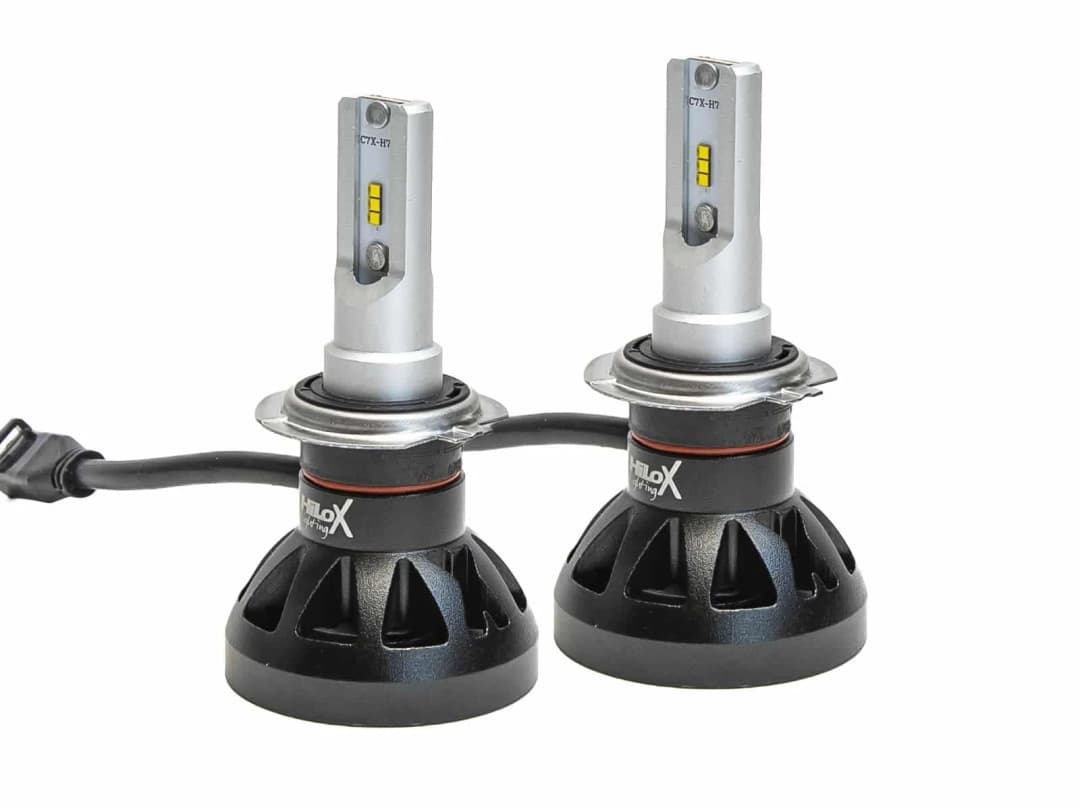
The owner's tip: make sure you have enough space (55mm) to put the LED in the headlight. A LED lamp has cooling at the back, so it is longer than a halogen lamp. Remove the dust cap and measure the depth from the lamp holder to the cap. When space is tight, a deeper rubber housing cap can help.
3. CAN-bus
Many modern cars check whether their lamps work. Because a LED uses less power than halogen, such a car may report a defective lamp. The H7 XTR Black LED kit, 5700K, Hilox Evolution comes with a CAN-bus II module per lamp according to the product information. More options at CAN-bus LEDs.
4. Light output
The owner found the light output the same as the xenon kit in his previous car. According to the product information, the H7 XTR Black gives 3600 lumen per lamp, which is 3.5 times more light than halogen, at 5700K. Its Luxeon Z ES chips last up to 50,000 hours, and the LED can be rotated 360 degrees to fine-tune the light image.
LED or xenon?
Both give a whiter and stronger light than halogen. The difference the owner noticed: LEDs are on immediately and do not have to start up, while xenon needs a short warm-up time and works with ballasts. Prefer xenon anyway? See our xenon kits.
After installation, have the light beam checked and make sure your car still meets the APK requirements. If in doubt, ask the RDW or your inspector. The Hilox product information states that LED lamps with an H fitting designation cannot obtain ECE approval and are intended for circuit and private terrain use only.