Hilox Lighting
Research LED low beam kits - Do's and don'ts

Research LED low beam kits - Do's and don'ts

Redactie Hilox Lighting
Door Redactie Hilox Lighting
Gepubliceerd
Leestijd
4 min

Short answer

What should you pay attention to when buying LED low beam kits?

When you compare LED low beam kits, look first at the LED chips: they say a lot about quality, durability and the ultimate price. Chip on board LEDs have a poor focal point, Cree LEDs have a limited radiation angle, and Philips Lumileds Luxeon Z ES chips match the size and position of the halogen filament. Also choose a kit with few, compact and waterproof connectors.
  • Chip on board (COB) LEDs are cheap to produce but give a poor light image and disappointing life expectancy.
  • Cree single SMD LEDs have a limited radiation angle and are often counterfeited.
  • Luxeon Z ES chips are developed mainly for the automotive industry.
  • Check the chips before you buy, because counterfeits of other brands are common.

LED lighting is becoming increasingly popular, due to the high light output and the economical power consumption. On the internet, lots of information is spread about LED lamps and there are numerous products for sale. As a result, it is very difficult for consumers to know what to do. This blog answers the question what you should really pay attention to when looking for LED headlights, so your car will be fitted with the kit that is best for your car.

First of all, a short introduction of how we have come to this research. As an Industrial Engineering student at TU Eindhoven, I wanted to do an internship at an e-commerce company where innovation is the highest priority. At Hilox, I could also combine that with the passion for light we know from Eindhoven. As I deepened into the subject LED low beam headlights, it turned out to be very difficult for consumers to make a sensible choice. That is why I have made the most out of TU/e knowledge and the experience of Bobby, owner of Hilox. This research answers the question where you should really pay attention to when looking for LED headlights, so your car, motorcycle or truck will be fitted with the kit that is best for it.
LED chips in LED low beam kits

If you want to compare a LED, look first at the led chips that are being used. The LED chip says a lot about quality, durability and the ultimate price. Typically, we encounter 3 types of led chips.

  1. Chip on board: In this type of led, multiple leds are placed on 1 chip. Often, lower and higher quality LEDs are used interchangeably in the chip so that it seems to be fine for the eye, but the quality is a lot lower and the color is often not very great either. These types of LEDs often have a very high light output and are cheap to produce. The disadvantage of these COB led chips is that they do not have a good focal point because of the large surface area, which means that the light image and color are not always as tight or even very bad. Also, life expectancies are often very disappointing. Although they have extremely high light output, the amount of useful light in the headlight is quite limited. You can recognize them by a large yellow surface.
  2. Cree (single SMD) LED chip: With this LED, all the light comes from 1 LED chip. Cree is a leading manufacturer of LED chips that produces fine quality LEDs with high light output for a wide range of applications such as flashlights, automotive lighting and bicycle lights. These LEDs often have a plastic optic that acts as a kind of projector. Now you can wonder if a projector in a projector headlight will deliver the desired result. This is also a good solution but there are better solutions in the market. The disadvantage of the Cree led's is that the radiation angle is limited, which means that you will have a poor light image faster. We also see a lot of counterfeit Cree leds produced in China.
  3. Philips Lumileds Luxeon Z ES (single SMD) LED chip: This is the latest technology and best quality LED chip with the highest light output. These are minuscule flat led chips, several of which are placed in one row on the led body. These led chips are mainly developed for the automotive industry and therefore we do not see them much in other applications. These LED chips are so small that you get the exact size of the filament and position of the halogen lamp focal length. This is very important for getting a perfect light image and the highest light output. There are no further disadvantages for this type of LED. These are the LED chips you can also find in our Hilox LED headlights.

PRO tip: Check the chips

Before you buy a led for your headlight or dipped beam, take a good look at what LED chips are being used and whether it's no counterfeit: if there is one thing China is good at, it's very accurate copycatting of other brands.

Connectors

Connectors are available in all types and sizes. To prevent these connectors from being defective, you do not want any unnecessary wires and connectors in your LED kit. In addition, you want the connectors to be absolutely waterproof, and not too large. Fortunately, there are also LED kits using high quality connectors: compact waterproof connectors, similar to audio connectors.

From research to practice: a buyer's checklist

The research above comes down to a few checks you can do yourself before you order a LED kit for your headlights.

  1. Which chip is used? Look for the chip type in the product information. A large yellow surface points to a chip on board LED.
  2. Does the chip match the halogen filament? The smaller and flatter the chips, the closer they get to the size and position of the original filament, and the better the light image in the headlight.
  3. Is the kit CAN-bus proof? Many modern cars check whether their lamps work. A LED uses less power than halogen, so without a CAN-bus solution the car may report a defective lamp. See our CAN-bus LEDs.
  4. How many wires and connectors? Fewer connections means fewer points that can fail. Waterproof and compact connectors are the safest choice.
  5. Is there space behind the headlight? Check the size of the lamp, the driver and any CAN-bus module before you buy.

An example from the Hilox range

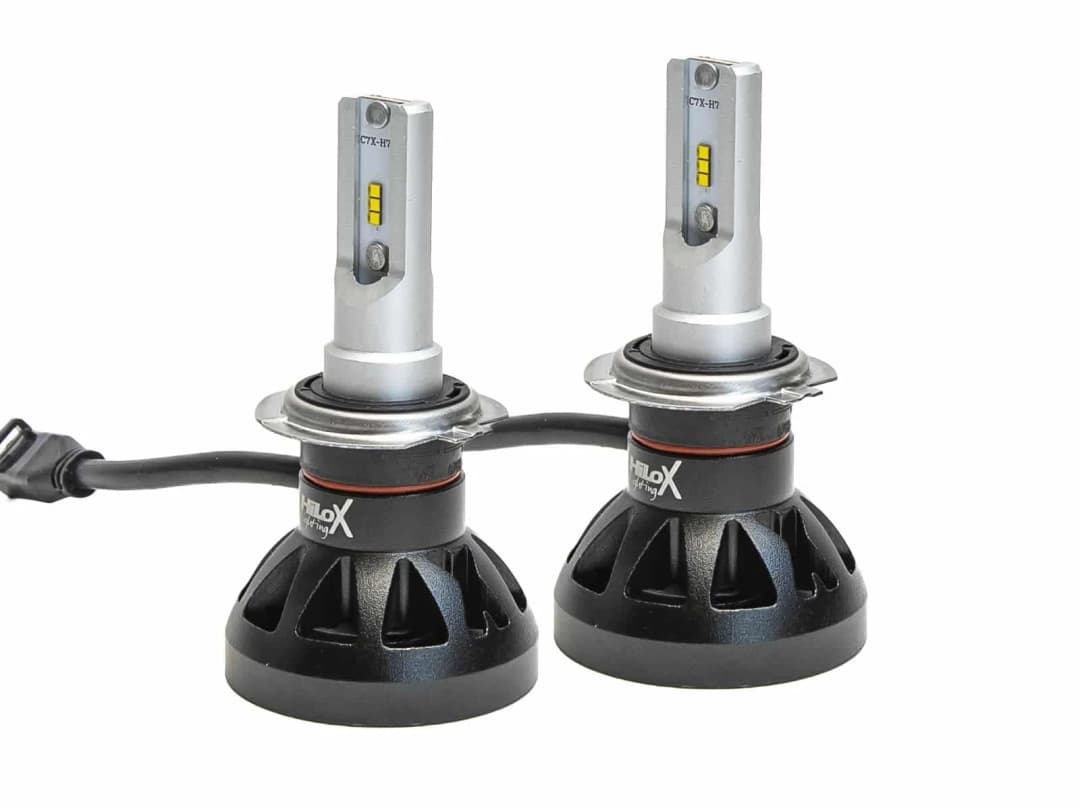
The H7 XTR Black LED kit, 5700K, Hilox Evolution uses the Luxeon Z ES chips from Lumileds (Philips) described above. According to the product information, it gives 3600 lumen per lamp, which is 3.5 times more light than halogen, and the chips last up to 50,000 hours. The kit includes a CAN-bus II module per lamp, is IP68 waterproof and can be rotated 360 degrees to fine-tune the light image in reflector and lens headlights.

After installing any LED kit, have the light beam checked and make sure your car still meets the APK requirements. If in doubt, ask the RDW or your inspector. Want to know which LED fits which light unit of your car? Read our LED purchasing guide.

Frequently asked questions about LED low beam kits

What is the disadvantage of chip on board LEDs?
Because of the large surface area, COB LED chips do not have a good focal point. The light image and colour are not always tight, life expectancy is often disappointing and the amount of useful light in the headlight is limited.
How do you recognize a chip on board LED?
You can recognize a chip on board LED by a large yellow surface.
Why are Luxeon Z ES chips good for headlights?
They are so small that they match the exact size of the filament and the position of the halogen lamp focal length. That is very important for a perfect light image and the highest light output.
What should the connectors of a LED kit be like?
You do not want unnecessary wires and connectors. The connectors should be absolutely waterproof and not too large, like compact waterproof connectors similar to audio connectors.
Stook in

Eens per maand,
een echte brief.

Nieuwe producten, montagetips en acties. Geen ruis, nooit doorverkocht.