Hilox Lighting
One xenon bulb is not another xenon bulb

One xenon bulb is not another xenon bulb

Redactie Hilox Lighting
By Redactie Hilox Lighting
Published
Reading time
2 min

Short answer

How do you recognise a good xenon bulb?

You can spot a quality xenon bulb by its metal base, a ceramic socket that carries the heat away, and silicone cabling. A cheap xenon bulb has a plastic base, a glued-in bulb and plastic cabling, which means low light output and a messy beam pattern.
  • Cheap xenon bulbs cost roughly 10 to 30 euros each.
  • A plastic base cannot get rid of its heat properly, which can mean a short lifespan.
  • A poor fit gives a poor beam pattern that dazzles oncoming traffic.
  • The cabling carries a high voltage of 35,000 volts to the bulb.

Junk vs. quality...

Xenon bulb land is a bit of a jungle when it comes to quality and price of xenon bulbs. So how do you separate the wheat from the chaff?

Below you can read how the different xenon bulbs on today's market compare. We used the H7 xenon bulb as our example.

The cheap xenon bulb

Quality is hard to find in this bulb. It has a plastic base and the glass is made from cheap material. The xenon gas inside is poor quality too. Prices for these bulbs run from 10 to 30 euros each.

You can recognise the low-quality xenon bulb by:

  • Plastic base, poor fit
  • Bulb glued into the base
  • Plastic cabling
  • Low light output
  • Limited lifespan
  • A poor beam pattern, so the car or motorcycle dazzles oncoming traffic and gets rejected at the Dutch APK inspection

Because the base of the bulb is plastic, it cannot get rid of its heat properly, which in some cases means a short lifespan and a poor fit in the headlight. That poor fit also risks a bad beam pattern that dazzles other road users.

The quality xenon bulb

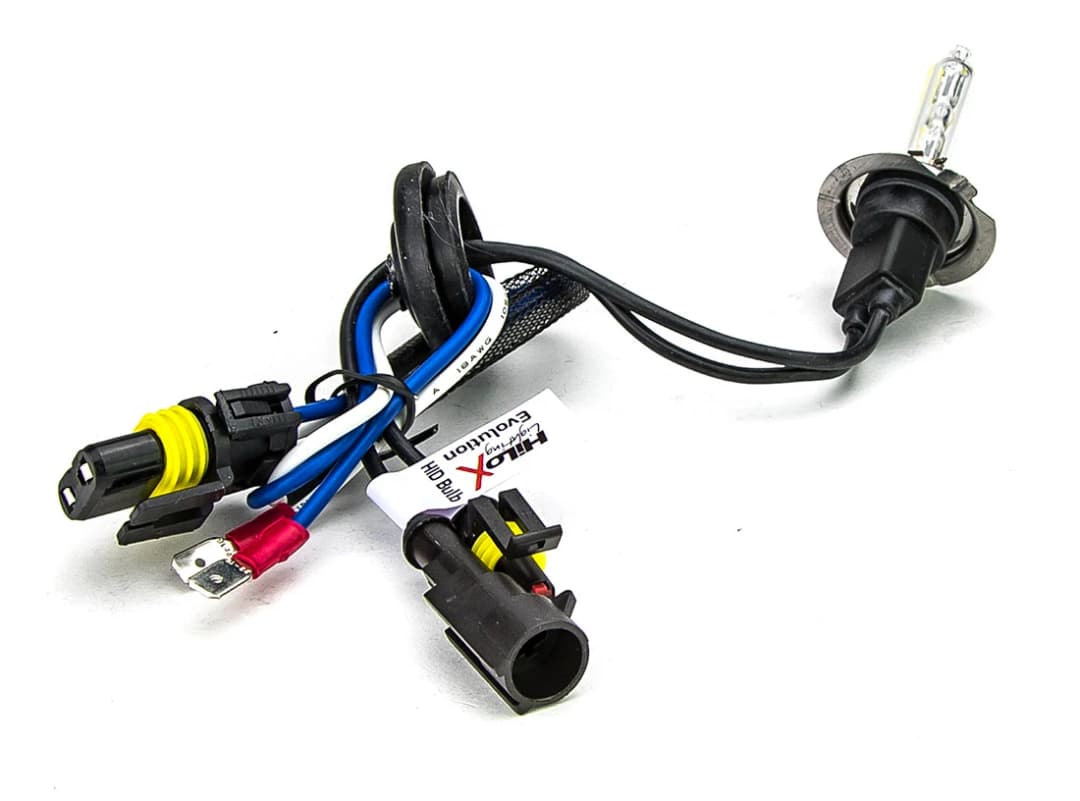
The quality xenon bulbs (the ones we sell) are visibly better built. The base is usually metal or hardened plastic, with the bulb sitting in a ceramic socket. The xenon gas inside is very durable stuff, so the bulbs last longer and keep their colour longer.

You can recognise the quality bulb by:

  • Metal base
  • Ceramic socket
  • Silicone cabling

These quality xenon bulbs have a ceramic socket that carries the heat away from the bulb perfectly. The silicone cabling also conducts best the high voltage of 35,000 volts that is sent to the bulb through one thin little wire.

Specs to look at when buying a xenon bulb

A good supplier tells you exactly what you are buying. If wattage, light output or lifespan are missing from the description, that is already a signal. As an example, here are the specs of the H7 Xenon Bulb, 4200lm Hilox Evolution II Black:

  • Wattage: 35W
  • Light output: 4,200 lumen per bulb
  • Operating voltage: 11 to 30V
  • Lifespan: 3,600 hours
  • Glass: anti-UV quartz tube from Germany, with a UV protection shield
  • Gas: metal halide xenon gas from the United States
  • Electrode: Plansee from Australia
  • Cabling: double shielded
  • Use: low beam, high beam and fog light

Parts like the electrode, the gas and the glass decide how long a bulb lasts and how long it keeps its colour. Shielded cabling helps prevent faults. Note: according to the product information, these bulbs have no ECE approval or E-mark (E-keur) and are not meant for public roads, but for circuit and private land use.

Colour temperature: what does Kelvin mean for xenon?

The colour of xenon light is expressed in Kelvin (K). The lower the number, the warmer and more yellow the light. The higher it gets, the whiter and eventually bluer it becomes. Roughly:

  • 4300K: warm white light, close to the colour of a lot of factory xenon.
  • 5500K: bright white light.
  • 6500K: cool white light with a slight blue tint.

Which colours you can choose differs per product. The H7 xenon kit Hilox Evolution II Black comes in 4300K, 5500K and 6500K, the H1 Solo and the D2S kit in 5500K and 6500K. When you replace a single bulb, always pick the same colour as the other side. Even better: replace them as a pair, because even good bulbs can drift a little in colour over time.

When should you replace a xenon bulb?

A xenon bulb rarely dies from one moment to the next. You will usually see warning signs first:

  • The colour changes: the light turns pinker, more purple or bluer than the other side.
  • The bulb visibly puts out less light than before.
  • The bulb flickers, or switches itself off after a while once it has lit.
  • The bulb needs more and more attempts to light up.

If a bulb does not light at all anymore, first check whether the bulb or the ballast is to blame. You can do that by swapping the left and right bulbs: if the problem moves with the bulb, the bulb is the culprit. If it stays on the same side, the ballast or the connection is the cause.

Factory xenon usually uses D bulbs such as D1S, D2S and D3S. You will find those under the OEM xenon bulbs. For a conversion kit with an H fitting, have a look at the xenon kits. Also read what the best xenon kit is for your car or motorcycle.

Frequently asked questions about xenon bulb quality

What does a cheap xenon bulb cost?
Cheap xenon bulbs cost between 10 and 30 euros each.
How do you recognise a cheap xenon bulb?
By a plastic base with a poor fit, a bulb glued into the base, plastic cabling, low light output, a limited lifespan and a poor beam pattern.
Why is a ceramic socket better?
A ceramic socket carries the heat away from the xenon bulb well. A plastic base cannot get rid of its heat properly, which can lead to a short lifespan and a poor fit.
Why does a xenon bulb have silicone cabling?
Silicone cabling conducts best the high voltage of 35,000 volts that is sent to the bulb through one thin little wire.
How do you know whether the bulb or the ballast is broken?
Swap the bulbs left and right. If the problem moves with the bulb, the bulb is to blame. If it stays on the same side, the ballast or the connection is the cause.
Fire it up

Once a month,
a real letter.

New products, fitting tips and offers. No noise, never sold on.

Made withNeuramerce