Hilox Lighting
Pilot Xenon Customer Survey
Redactie Hilox Lighting
By Redactie Hilox Lighting
Published
Reading time
1 min

Short answer

Why did customers choose Pilot xenon lighting?

The Pilot xenon customer survey, with 224 responses, shows that quality is one of the biggest reasons to buy. More light, a good look, warranty, safety and ease of fitting weigh heavily too: 64% think it is extremely important to see more in the evening and at dusk.
  • Participants gave each topic a score from 1 to 5.
  • At the time, Pilot xenon had been known as one of the best-quality brands for about 8 years.
  • According to research by the German TÜV, the number of road casualties would fall by 30% if everyone drove with xenon.
  • Most customers fit the xenon themselves.

From 224 responses we were able to draw a clear conclusion about why our customers chose Pilot xenon lighting. Read all about it in this article, which we're publishing on the back of the survey.

Participants could give each topic a score from 1 to 5, with 5 as the highest.

Topics

  • Quality
  • More light
  • A more luxurious look
  • Warranty
  • Safety
  • Ease of fitting

Pilot xenon customer survey: the results

Quality is one of the biggest reasons for buying Pilot xenon from us. Pilot xenon has been known as one of the best-quality brands for about 8 years now.

More light and therefore better visibility also scores very high in our survey. 64% think it is extremely important to see more in the evening and at dusk.

A good look matters a lot too. Not everyone shares that view, but if you're spending a good 200 euros on more light for your car, it may as well look nice. And because "nice" means something different to everyone, we have a number of different xenon colours in our range.

Warranty on xenon lighting is considered very important. If something ever breaks, you naturally want it repaired or replaced as quickly as possible.

Safety is a big issue in car and motorbike land, and our participants think so too. Xenon lighting does its bit for safety. Research by the German TÜV has shown: ‘if everyone drove with xenon lighting, the number of road casualties would fall by 30%’.

Fitting xenon isn't all that hard, and most of our customers do it themselves. But a percentage heads to a good friend or even a garage.
Quality and warranty: what to look for in a xenon kit

Quality and warranty scored high in the survey. But how do you judge that yourself when choosing a xenon kit? A few concrete points:

  • The bulb: a metal base and a ceramic base shed heat better than plastic. Read more in not every xenon bulb is the same.
  • The ballast: it determines how stable the bulb burns and how the kit works with your car. If your car has lighting monitoring, you need a kit with a CAN-bus module.
  • Specifications: a good supplier states wattage, light output and lifespan.
  • Warranty: check how long the warranty is and which parts it covers.

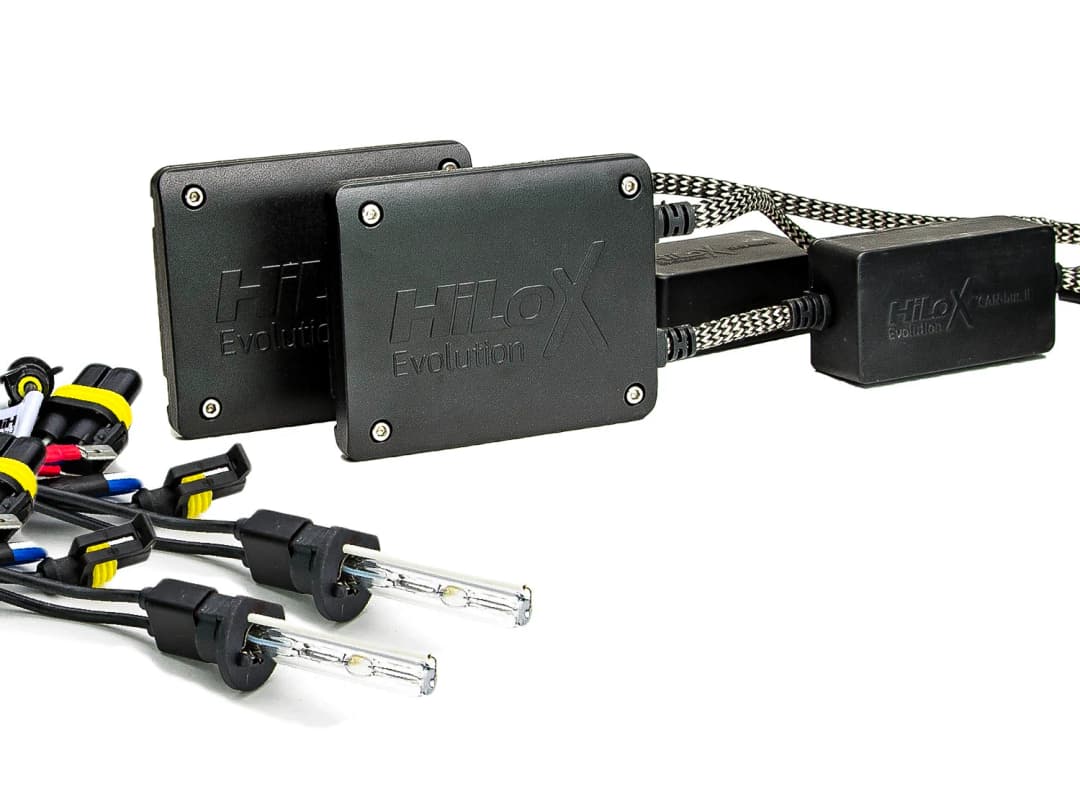
As an example from the current range: according to the product data, the Hilox Evolution II Black xenon kits come with a 2-year warranty on both the bulbs and the ballasts. The ballasts have an IC chip that keeps the current stable and a CAN-bus II module. Note: according to the product information, these kits have no ECE approval or E-mark and are not intended for public roads, but for the track and private land.

Choosing more light and a nice colour

With xenon, more light and a good look go hand in hand, but they are two different choices.

Light output is expressed in lumens. The more lumens, the more light the bulb gives. According to the specifications, the H7 xenon bulb Hilox Evolution II Black gives 4,200 lumens per bulb at 35W.

Colour is expressed in Kelvin (K). A lower value gives warmer, white-yellow light. A higher value gives whiter and eventually bluer light. Which colour you find nice is personal: exactly why there are several colours in the range. The H7 xenon kit Hilox Evolution II Black, for instance, is available in 4300K, 5500K and 6500K.

Tip: always choose the same colour left and right, and preferably replace bulbs in pairs, so the beam pattern stays the same.

On the road safely: fit it yourself or have it done

Most participants fitted the xenon themselves. That's perfectly doable if you've replaced a headlight bulb before. The broad strokes:

  1. Switch off the ignition and lights and open the back of the headlight.
  2. Replace the halogen bulb with the xenon bulb. Don't touch the glass.
  3. Connect the ballast to the bulb connector and the bulb, and test everything before you tuck it away.
  4. Fix the ballast firmly in a dry spot, away from hot engine parts.
  5. Close the headlight up again so it is watertight.

If you're unsure or short on space, ask a handy friend or a garage, as some of the participants did too. Safety stands or falls with a properly aimed beam: more light only helps if it lands on the road and not in the eyes of oncoming drivers. After fitting, have the beam aimed and check whether your car still meets the APK (the Dutch roadworthiness test) requirements; if in doubt, check with the RDW (the Dutch vehicle authority) or your inspector.

You can read a more detailed step-by-step guide in xenon in your car: how to go about it.

Frequently asked questions about the Pilot xenon survey

How many customers took part in the survey?
224 responses came in. Participants could give each topic a score from 1 to 5, with 5 as the highest.
Which topics were rated?
Quality, more light, a more luxurious look, warranty, safety and ease of fitting.
How important is more light to customers?
64% think it is extremely important to see more in the evening and at dusk.
What does the TÜV say about xenon and safety?
Research by the German TÜV has shown that the number of road casualties would fall by 30% if everyone drove with xenon lighting.
Do customers fit the xenon themselves?
Most customers do it themselves. Some have a good friend or a garage do it.
Fire it up

Once a month,
a real letter.

New products, fitting tips and offers. No noise, never sold on.

Made withNeuramerce